Importing olive wood to the USA: what a Lacey Act declaration asks for
BY THE ARTISRAW EDITORIAL TEAM · AUGUST 11, 2026 · UPDATED OCTOBER 6, 2026 · 9 MIN READ
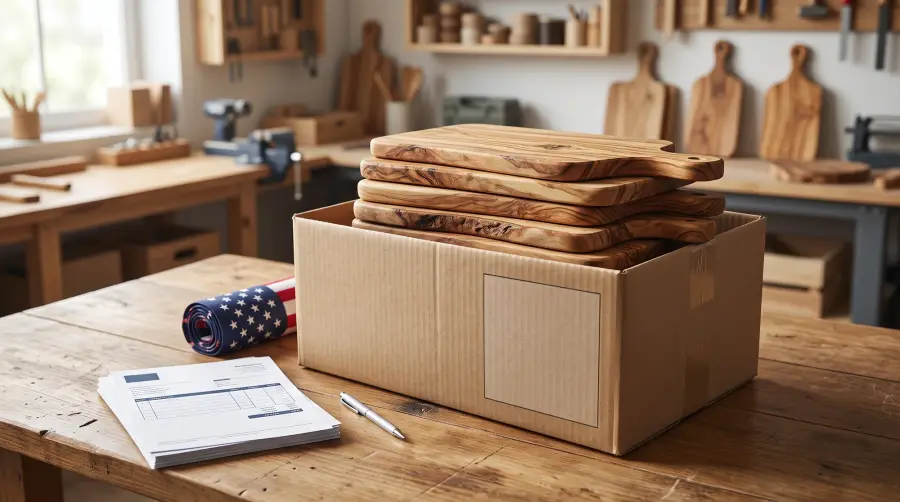
The declaration is short. What makes it easy is having the species, the origin and the classification settled before the goods move.
A Lacey Act declaration asks for the scientific name of the plant, the country it was taken from, the quantity in metric units and the value — for Tunisian olive wood that is Olea europaea and Tunisia — and it is filed by the importer of record, not by the manufacturer. A declaration is required when three things are all true: the shipment contains plant material, it is classified under an HTS code on the APHIS implementation schedule, and it enters as a formal entry.
This guide sets out the fields, which side of the transaction produces each one, why the de minimis exception does not help a wooden product, and the sequence that keeps a first US order out of trouble. It is a practical summary for buyers, not legal advice.
What the law actually requires
Two things, and they are separate.
- A substantive prohibition. It is unlawful to import plants or plant products taken in violation of the law of the country they came from. This part has nothing to do with paperwork: it is about whether the material was lawfully harvested.
- A declaration requirement. For goods in the covered HTS codes, the importer files a plant and plant product declaration — PPQ Form 505, or its electronic equivalent through the customs filing — naming the species, the country of harvest, the quantity and the value.
Both land on the importer of record, which is the buyer rather than the manufacturer. That is exactly why documentation from the supplier matters: it is the evidence behind what you declare, and it is you who signs it.
The fields, and who produces each one
This is the table to send to whoever prepares your entries. The left column is what the declaration asks for; the right column is where the answer comes from.
| FIELD ON THE DECLARATION | FOR AN ARTISRAW SHIPMENT | WHO PRODUCES IT |
|---|---|---|
| Scientific name (genus and species) | Olea europaea | ArtisRaw, in writing with the shipment |
| Country from which the plant was taken | Tunisia | ArtisRaw |
| Quantity of plant material, in metric units | Per line, from the packing list | ArtisRaw |
| Value of the product | From the commercial invoice | ArtisRaw invoice, entered by your broker |
| HTS code | Generally 4419 for tableware and kitchenware, 4420 for decorative articles | Agreed between you, your broker and our classification |
| Description of the shipment | Per line, from the invoice and packing list | ArtisRaw |
| Importer and consignee names and addresses | Yours | You |
| Bill of lading, container number, manufacturer identification code | From the shipment itself | Forwarder and ArtisRaw |
| The filing | PPQ 505 or the electronic message set | You, as importer of record |
Field list from the APHIS Lacey Act declaration requirements and PPQ Form 505. Full references at the end.
Species: one line that has to be right
The botanical entry is Olea europaea L. — the cultivated olive. Chemlali is a cultivar of that species, not a separate species, so it belongs in your product description and your marketing, not in the species field. What Chemlali is, and what research has and has not shown about it →
Two names cause most of the confusion in this category, and both are worth knowing before you compare two suppliers’ paperwork:
- Russian olive (Elaeagnus angustifolia) is not an olive at all. Different genus, different family, no relation.
- East African olive (Olea capensis) is a close relative whose timber is difficult to distinguish from Olea europaea by eye, and it is not grown for fruit.
If a supplier offers “olive wood” without naming the species and the country of harvest, they are offering you something you cannot declare. Ask, and get it in writing — the same discipline that makes two “acacia” quotations comparable. Why a trade name is not a species →
Classification decides whether you file at all
The declaration requirement has been phased in by HTS code since 2009, and APHIS publishes the current implementation schedule. Wooden tableware and kitchenware generally classify under heading 4419; decorative articles of wood under 4420. Your broker will confirm the exact line for your specific mix, and because the classification also determines duty, it is worth settling before the first order rather than at the port.
Where the wood comes from, in practice
The country-of-harvest field has a story behind it, and under the substantive prohibition that story is the part that matters. In Tunisia, felling or uprooting olive trees without authorisation is prohibited under Law No. 61-20 of 1961, as amended. Our timber therefore comes from pruning in the normal agricultural cycle and from trees that have stopped producing fruit and are taken out of the grove as part of its management, under a forestry licence. No tree is felled to make a serving board.
That is the same documented chain the EU due-diligence dossier rests on, which is convenient if you sell into both markets. What EU importers need, and which date applies to them → · How our olive wood is sourced →
What we supply, and what you file
| ARTISRAW SUPPLIES | YOU OR YOUR BROKER DO |
|---|---|
| Commercial invoice and packing list | File the entry and the plant declaration |
| Certificate of origin | Confirm the HTS lines against the actual SKU mix |
| HS classification for the goods as we understand them | Accept, or correct, that classification as importer of record |
| Species (Olea europaea) and country of harvest (Tunisia), in writing | Enter them on the declaration and keep the evidence on file |
| ISPM-15 heat-treated and marked export pallets | Check the marks on arrival |
| ISO 9001:2015 certificate and the rest of the export document set, on request | Decide what your own compliance file needs |
The export documentation list, including which certificates we can issue and which we request from a third party, is on our quality and certifications page.
Practical sequence for a first US order
- Settle the HS lines with your customs broker, against the specific SKUs on the order — not against the category.
- Check those lines against the current APHIS implementation schedule, since the requirement is phased by code and the schedule has moved before.
- Ask us for the export pack: invoice, packing list, certificate of origin, HS classification, species and country of harvest.
- Confirm ISPM-15 treatment on the pallets. Ours are heat-treated and marked.
- Agree the grading tolerance before the batch is cut. Not a customs matter, but the other thing that delays a first order. How the minimums work →
- Plan the freight around volume, not weight. The landed-cost arithmetic →
None of this is unusual for a wood importer, and none of it is slow once the first shipment has set the pattern. What causes delay is discovering at the port that nobody agreed the HS line.
Frequently asked questions
Does olive wood need a Lacey Act declaration?
If the shipment contains plant material, is classified under an HTS code on the APHIS implementation schedule, and enters as a formal entry, then yes — a declaration is required, and wooden tableware and kitchenware generally classify in heading 4419, decorative articles of wood in 4420. All three conditions have to apply, and the schedule is phased in by HTS code, so the line your products classify under is what settles it. Confirm the current position with your customs broker before entry.
What goes on the declaration for Tunisian olive wood?
The scientific name is Olea europaea and the country from which the plant was taken is Tunisia. Chemlali is a cultivar of that species, not a species in its own right, so it does not change the botanical entry — it belongs in your product description, not in the species field. The form also needs the HTS code, the quantity in metric units, the value, and the importer and consignee details.
Who files the declaration, the importer or the manufacturer?
The importer of record files it, and that is the buyer. A manufacturer outside the United States cannot file on your behalf. What a supplier can and should do is give you the evidence the declaration rests on — species, country of harvest, quantity, value and the classification — in a form your broker can use. You sign it; we supply what it is built from.
Does the de minimis exception cover wooden kitchenware?
No. The exception applies where plant material is no more than 5% of the total weight of the individual product unit, and where the total plant material in an entry under the same 10-digit HTS provision does not exceed 2.9 kilograms. A solid olive wood board is 100% plant material, so neither test is close to being met. The exception is for products with incidental wood content, not for wooden goods.
What documents does ArtisRaw send with a US shipment?
The commercial invoice, the packing list, the certificate of origin, the HS classification, and the species and country-of-harvest data a declaration needs, with ISPM-15 heat-treated and marked pallets. That is the evidence set; the declaration itself is filed by your broker. Other certificates, including the ISO 9001:2015 certificate and the export documentation list, are available on the quality and certifications page.
Is olive wood a CITES or endangered species?
Olea europaea is not a CITES-listed species. It is the cultivated olive, grown across the Mediterranean for its fruit, and in Tunisia felling or uprooting an olive tree without authorisation is prohibited by law — which is why the wood comes from pruning and from trees at the end of their fruiting life. The Lacey Act question is not whether the species is protected but whether the material was taken lawfully where it grew.
What happens if the species on the declaration is wrong?
The declaration is a legal statement by the importer, so an error is the importer’s problem first, which is why the species has to come from the supplier in writing rather than from a catalogue description. Two names cause most of the confusion: Russian olive (Elaeagnus angustifolia) is an unrelated tree in a different family, and East African olive (Olea capensis) is a close relative whose wood is hard to tell apart. Ask which species, and get the answer on paper.
Sources
- USDA APHIS. Lacey Act declaration requirements — the field list, the three conditions, and the de minimis exception (5% of unit weight; 2.9 kg per 10-digit HTS provision per entry). aphis.usda.gov. Accessed October 2026.
- USDA APHIS. PPQ Form 505, Plant and Plant Product Declaration — HTS number, article/component, plant scientific name, country of harvest, quantity of plant material. ppq505.pdf
- Republic of Tunisia. Law No. 61-20 of 31 May 1961 prohibiting the felling and uprooting of olive trees, as amended by Law No. 2001-119. ECOLEX record
- The Wood Database. Olive (Olea europaea) and the note on Olea capensis and Elaeagnus angustifolia. wood-database.com/olive
This is a practical summary for buyers, not legal advice. The declaration is filed by the importer of record, and the enforced HTS schedule changes; confirm the current position with your broker before entry.
About ArtisRaw. ArtisRaw (STE ART IS RAW) manufactures handmade Chemlali olive wood kitchenware, tableware and décor in Sfax, Tunisia, for retailers, distributors, hospitality groups and private-label brands. Its quality management system is certified ISO 9001:2015 by Bureau Veritas, certificate n° 45.2025.0143, valid November 2025 to November 2028. Route Saltnia Km 4.5, Sfax, Tunisia.
Shipping to the US? Ask for the export pack with your quotation, so your broker has it before the goods move.
Request a wholesale quote