Olive wood vs acacia vs bamboo: what the published figures say
BY THE ARTISRAW EDITORIAL TEAM · MAY 20, 2026 · UPDATED OCTOBER 6, 2026 · 9 MIN READ
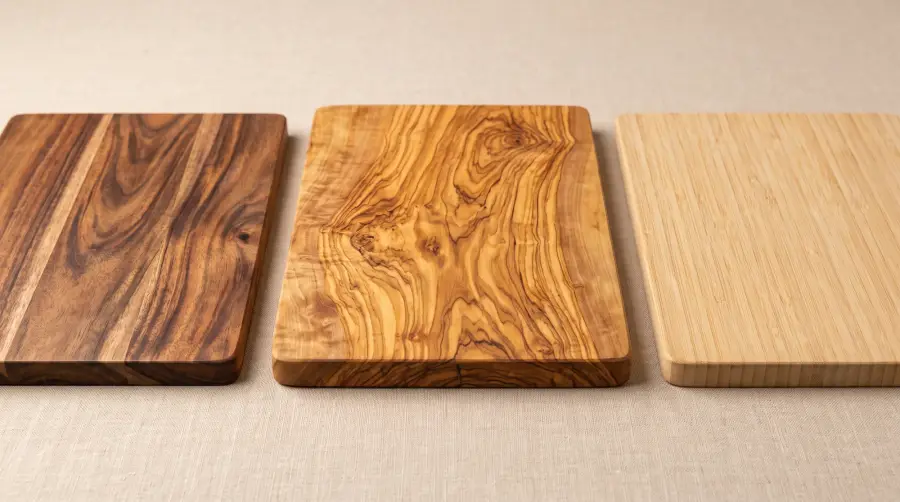
Three materials, three different products: laminated bamboo, uniform acacia, and olive wood where no two pieces match.
Olive wood is the hardest and densest of the three and the only one that can be refinished for years; bamboo is the lightest and cheapest and cannot be repaired once a glue line opens; acacia sits between them, but “acacia” is a trade name and not a species. On published figures: olive wood 980 kg/m³ and 2,710 lbf Janka, the two Acacia species with full data 640–730 kg/m³ and 1,160–1,710 lbf, bamboo 500–850 kg/m³ and 1,410–1,610 lbf. Every number on this page comes from The Wood Database and is cited in the table.
This guide compares the three the way a buyer has to: by the figures that decide how a piece behaves on a shelf and in a customer’s kitchen, by what the words on a spec sheet actually commit a supplier to, and by where each belongs in a range. We make olive wood, so we have an interest in the answer — which is why the numbers are sourced and the opinions are labelled as ours.
The three materials, side by side
Hard maple is in the table as a reference point, because it is the timber most cutting-board specifications are written against. Read the acacia column as a range: these are two named species, not “acacia”.
| PROPERTY | OLIVE (OLEA EUROPAEA) | ACACIA (TWO NAMED SPECIES) | BAMBOO | HARD MAPLE |
|---|---|---|---|---|
| Average dried weight | 980 kg/m³ | 640 kg/m³ (A. melanoxylon) · 730 kg/m³ (A. mearnsii) | 500–850 kg/m³ | 705 kg/m³ |
| Janka hardness | 2,710 lbf (12,060 N) | 1,160 lbf · 1,710 lbf | 1,410–1,610 lbf | 1,450 lbf |
| Shrinkage, radial / tangential | 4.9% / 7.7% | 3.9% / 7.9% · 3.1% / 7.0% | Diameter 10–16%, wall 15–17% | 4.8% / 9.9% |
| Structure | Solid hardwood, diffuse-porous, fine and even | Solid hardwood | A grass; kitchenware is strips laminated with adhesive | Solid hardwood, close-grained |
| Can it be refinished? | Yes — sand 240 then 400 grit and re-oil | Yes | Surface only; an open glue line ends the piece | Yes |
| Appearance | No two pieces alike: dark streaked heartwood, pale sapwood, burl | Uniform mid to dark brown | Repeating strip pattern | Pale and even |
| Typical supply | Pruning and end-of-life orchard trees | Plantation | Plantation, East Asia | Managed forest, North America |
Source for every figure: The Wood Database — Olive, Australian Blackwood (Acacia melanoxylon), Black Wattle (Acacia mearnsii), Bamboo and Hard Maple. Bamboo and acacia are given as ranges because both names cover more than one plant. Full references at the end.
“Acacia” is a trade name, not a species
This is the single most useful thing on the page for a buyer. Acacia is a genus of more than a thousand species, and The Wood Database says plainly that merchants “are quite fond of using the acacia name despite its inherent vagueness”, noting that density across the genus is “greatly variable” — from woods lighter than black cherry to some of the heaviest on earth.
So two quotations for “acacia serving boards” can be for genuinely different timbers at the same price, and the difference shows up in your returns, not in the offer. Three practical consequences:
- Ask for the species on the purchase order, in Latin, not the trade name. The same discipline a US customs declaration requires anyway.
- Compare hardness against that species, not against the word. 1,160 lbf and 1,710 lbf are both “acacia”, and one marks under a knife far sooner than the other.
- Olive wood has the opposite problem solved for you: it is one species, Olea europaea, and ours is one cultivar of it, Chemlali from the Sfax region. What that cultivar is, and what research has and has not shown about it →
Bamboo has a version of the same ambiguity. It is a grass, not a timber, and the kitchenware form is strips of it bonded under pressure, so the published strength figures are properties of the plant rather than of the board you are buying. What holds a bamboo board together is the adhesive.
Hardness, and what it buys
Olive wood’s 2,710 lbf is nearly twice hard maple’s 1,450 lbf and 1.6 to 2.3 times the two named acacias. Hardness is a resistance-to-denting measurement, so what it predicts is how a surface looks after a year of knife work, not whether a board will split.
In practice the difference is repairability over a product’s life. Knife marks in olive wood stay shallow, so a board that has gone grey and scored comes back with 240 then 400 grit paper and two coats of oil — the restoration routine is in our care guide, and it is the same grit sequence the workshop finishes with. A solid acacia board can be refinished too. A laminated bamboo board cannot: once water has reached a glue line, sanding the face does not put the board back together.
For a retailer that difference is a conversation at the till rather than a specification: a piece that can be renewed is a piece that can be sold as something to keep.
Movement is the number that actually breaks boards
Hardness sells; movement is what generates returns. Every solid wood swells when it takes up moisture and shrinks when it loses it, and it does so unevenly — more across the grain than along the radius. Olive wood’s green-to-oven-dry shrinkage is 4.9% radial against 7.7% tangential, a ratio of about 1.6 to 1, and The Wood Database rates it as high movement and poor stability, particularly in branch wood.
The named acacias move slightly less across the grain (7.0% and 7.9% tangential, 3.1% and 3.9% radial), and hard maple more (9.9% tangential). None of them is immune. Two things follow:
- What the supplier dries to matters more for olive than for the alternatives. We dry to 10 ± 2% before cutting; why that number, and what happens either side of it.
- What the customer does matters most of all. A board left wet on one face cups, whatever the species. That is a care instruction, not a material defect, and it is the reason a care card belongs in the box.
Grain and shelf presence
Acacia is uniform brown. Bamboo is a repeating strip pattern. Olive wood is the only one of the three where no two pieces match: its figure comes from colour — dark brown and black streaks through a yellow to reddish-brown heartwood — rather than from open pores, and sapwood, burl and crotch figure all show.
That has a merchandising consequence and a buying one. The merchandising consequence is that olive wood is displayed face-up and photographed individually. The buying one is that “natural variation” has to be agreed in writing: a grading and figure tolerance against reference photographs, so that a shipment nobody would call wrong is also a shipment nobody calls a surprise. Olive wood cutting boards, with the grading notes →
Care, compared honestly
All three are hand-wash products. None belongs in a dishwasher: hot water, detergent and a heated dry cycle swell and shrink the material faster than it can cope with, and on a laminated board they attack the glue lines as well.
| CARE | OLIVE WOOD | ACACIA | BAMBOO |
|---|---|---|---|
| Washing | By hand, dried upright | By hand, dried upright | By hand, dried upright |
| Re-oiling | Monthly, or when water stops beading | Periodically, as the finish requires | Little to feed; the surface is sealed and glued |
| When it goes grey or scored | Sand 240 then 400 grit, oil twice | Can be sanded and re-oiled | Light surface sanding only |
| End of life | Retire when a crack runs through | Retire when a crack runs through | Retire when a glue line opens |
The honest summary: bamboo asks least because it offers least to maintain, olive wood asks for five minutes a month and gives back a surface that improves, and acacia sits between. What none of the three tolerates is a dishwasher.
Sourcing, and the documents each one brings
A sourcing story is only worth as much as the paperwork behind it, and this is where the three diverge most for an importer.
- Olive wood. In Tunisia, felling or uprooting olive trees without authorisation is prohibited under Law No. 61-20 of 1961. The wood therefore arrives from pruning and from trees at the end of their fruiting life, under a forestry licence, which is a traceable chain rather than a slogan: what EU importers need for their due-diligence statement, and what a US declaration asks for.
- Acacia. Plantation-grown, generally in South and South-East Asia or Africa. The documentation question is the species question again: a declaration needs the Latin name of the plant that is actually in the box.
- Bamboo. Grows back quickly, which is the basis of its reputation. It is also laminated with adhesive and shipped a long way, and the adhesive is part of the product you are selling.
We do not claim a carbon comparison between the three, because we have not measured one and neither, so far as we can find, has anyone else for these product categories. What we can document is where our own trees stood and under which licence they were taken out of the grove. How our olive wood is sourced →
Where each one belongs in a range
This part is our opinion, and we would rather say so than dress a ranging argument up as data. The three are tiers rather than substitutes:
- Bamboo opens the ladder. It is a volume commodity: light to ship, consistent, replaceable, and priced where a customer does not deliberate.
- Acacia fills the middle. Solid wood, uniform, familiar — the safe answer when a planogram needs a wooden block that nobody will complain about.
- Olive wood sits at the top. It is the only one of the three with figure that varies piece to piece, the hardest, and the one that can be renewed. That is a buy-it-once proposition, and it is sold with a story and a care card rather than on price.
A range carrying only one of the three competes on price at whichever end it chose. Most buyers who add olive wood add a focused block rather than a full line: one board, a set of servers from the spoons and spatulas range, and one statement bowl from the bowls and baskets range.
What to put on the purchase order
Whichever of the three you buy, these are the lines that prevent an argument later:
- Species, in Latin, and country of harvest. Olea europaea, Tunisia, in our case. Required for a US declaration anyway, and the only way to compare two “acacia” offers.
- Moisture content at despatch. Ours is 10 ± 2%.
- Finish. Ours is mineral oil and beeswax, applied by hand.
- Grading and figure tolerance, agreed against reference photographs — the line that matters most for a material with natural variation.
- Dimensional tolerance. Ours is ±1 mm on cut dimensions.
- Packing and documents: ISPM-15 heat-treated pallets, and the export set listed on our quality and certifications page.
Request a wholesale quote → · How minimum order quantities work → · What it costs to land it →
Frequently asked questions
Is olive wood harder than acacia?
Yes, on every published figure. Olive wood is 2,710 lbf (12,060 N) on the Janka scale, against 1,710 lbf for black wattle and 1,160 lbf for Australian blackwood, the two Acacia species The Wood Database gives full data for. That is 1.6 to 2.3 times harder. But “acacia” is a trade name covering a genus whose density The Wood Database calls “greatly variable”, so the honest comparison is against a named species, not against the word on the label.
What is acacia wood, exactly?
It is a genus of over a thousand species, not one timber. The Wood Database notes that merchants “are quite fond of using the acacia name despite its inherent vagueness”, and the genus runs from woods lighter than black cherry to some of the heaviest on earth. For a purchase order that matters: ask which species, because the hardness, the colour and the movement all change with the answer.
Is olive wood or bamboo better for cutting boards?
They are different products. Olive wood is a solid hardwood at about 980 kg/m³ and 2,710 lbf, which can be sanded and re-oiled for years. Bamboo kitchenware is strips of a grass laminated with adhesive, 500–850 kg/m³ and 1,410–1,610 lbf, which is light, cheap and consistent, and cannot be refinished once a glue line opens. Bamboo wins on price and weight; olive wood wins on life and on figure.
Which of the three lasts longest in use?
Solid olive wood, because it is the only one of the three that can be repaired. A pale, scored or stained olive board is sanded at 240 then 400 grit and re-oiled, and comes back darker than it started. A laminated bamboo board that delaminates is replaced, not restored. Acacia sits between: it is solid wood and can be refinished, but at 1,160–1,710 lbf it marks sooner than olive.
Which wood is easiest for a customer to look after?
All three want the same routine: hand wash, towel dry, dry upright, re-oil when the surface stops beading water. Bamboo asks the least because there is least to maintain. Olive wood asks for a monthly re-oil and rewards it. The figures behind that are its shrinkage — 4.9% radial against 7.7% tangential — which is why uneven drying, not knife work, is what damages a board.
Is bamboo more sustainable than olive wood?
It depends on what you are measuring, and neither claim should be made loosely. Bamboo grows back fast, but kitchenware bamboo is laminated with adhesive and travels from East Asia. Olive wood here is a by-product of agriculture: Tunisian law prohibits felling or uprooting olive trees without authorisation, so the wood comes from pruning and from trees at the end of their fruiting life, which is traceable to a licence and a grove.
Does olive wood move more than acacia or bamboo?
Olive wood moves more across the grain than the acacias do. Green-to-oven-dry shrinkage is 4.9% radial and 7.7% tangential for olive, against 3.1% and 7.0% for black wattle and 3.9% and 7.9% for Australian blackwood. The Wood Database rates olive as having high movement and poor stability, especially in branch wood, which is why drying it to a controlled moisture content before cutting matters more for olive than for the alternatives.
Which wood should sit at which price point in a tableware range?
Our view, and it is a ranging argument rather than a measurement: bamboo opens the ladder as a volume commodity, acacia fills the middle as uniform solid wood, and olive wood tops it as a piece no two of which are alike. The three are tiers rather than substitutes, and a range that carries only one of them is competing on price at whichever end it chose.
Sources
- The Wood Database. Olive (Olea europaea). wood-database.com/olive. Accessed October 2026.
- The Wood Database. Acacia genus overview — the trade-name note and “density greatly variable”. wood-database.com/acacia. Accessed October 2026.
- The Wood Database. Australian Blackwood (Acacia melanoxylon): 640 kg/m³, 1,160 lbf, shrinkage 3.9 / 7.9 / 11.9%. wood-database.com/australian-blackwood. Accessed October 2026.
- The Wood Database. Black Wattle (Acacia mearnsii): 730 kg/m³, 1,710 lbf, shrinkage 3.1 / 7.0 / 10.2%. wood-database.com/black-wattle. Accessed October 2026.
- The Wood Database. Bamboo: 500–850 kg/m³, 1,410–1,610 lbf, diameter shrinkage 10–16%, wall 15–17%. wood-database.com/bamboo. Accessed October 2026.
- The Wood Database. Hard maple (Acer saccharum): 705 kg/m³, 1,450 lbf. wood-database.com/hard-maple. Accessed October 2026.
- Republic of Tunisia. Law No. 61-20 of 31 May 1961 prohibiting the felling and uprooting of olive trees, as amended by Law No. 2001-119. ECOLEX record
- ArtisRaw workshop: 10 ± 2% moisture content, ±1 mm cut tolerance, mineral oil and beeswax finish, 80-to-400 grit sanding.
About ArtisRaw. ArtisRaw (STE ART IS RAW) manufactures handmade Chemlali olive wood kitchenware, tableware and décor in Sfax, Tunisia, for retailers, distributors, hospitality groups and private-label brands. Its quality management system is certified ISO 9001:2015 by Bureau Veritas, certificate n° 45.2025.0143, valid November 2025 to November 2028. Route Saltnia Km 4.5, Sfax, Tunisia.
Testing an olive wood block on your planogram? Start with one mixed pallet.
Request a wholesale quote